
The Critical Role of Capillary Networks
Microvascular circulation—the network of capillaries delivering blood to tissues—represents where metabolism actually occurs. Large arteries and veins transport blood, but capillaries perform the critical exchange of oxygen, nutrients, and waste products with tissue cells. These smallest blood vessels, with walls only one cell thick, allow diffusion between blood and surrounding tissue.
In diabetes, three organ systems with particularly dense and specialized capillary networks suffer disproportionate damage: the retina, the kidney glomeruli, and peripheral nerves. These tissues depend on precise microvascular function for survival. Retinal photoreceptors require constant nutrient delivery through retinal capillaries. Kidney filtration depends on glomerular capillary integrity. Nerve function requires adequate blood flow through vasa nervorum—the tiny vessels supplying peripheral nerves.
When diabetes damages these microvascular beds, the consequences extend beyond vascular dysfunction to organ failure. Retinal capillary damage progresses to vision loss. Glomerular capillary destruction advances to kidney failure. Nerve capillary compromise leads to neuropathy and eventual limb amputation. These complications—retinopathy, nephropathy, neuropathy—represent the human cost of microvascular deterioration.
The insidious nature of microvascular damage lies in its gradual, asymptomatic progression. Early changes occur silently while glucose readings may appear reasonably controlled. By the time symptoms manifest—vision changes, kidney function decline, numbness in extremities—substantial irreversible damage has already accumulated. The window for prevention closes before patients recognize threat.
Mechanisms of Capillary Destruction
Chronic hyperglycemia damages capillaries through multiple converging pathways. Endothelial cells lining capillaries experience direct glucose toxicity when exposed to elevated concentrations for years. High glucose activates biochemical pathways—particularly the polyol pathway and hexosamine pathway—that generate osmotic stress and alter cellular metabolism. Endothelial cells swell, lose their tight junctions, and become dysfunctional.
Advanced glycation end products accumulate in capillary walls, cross-linking structural proteins and reducing vascular flexibility. These glycated proteins also bind to receptors on endothelial cells, triggering inflammatory responses that further damage the vessels. The capillary wall becomes rigid, thickened, and unable to appropriately regulate blood flow or permeability.
Oxidative stress from chronic hyperglycemia overwhelms capillary antioxidant defenses. Reactive oxygen species damage endothelial DNA, proteins, and lipid membranes. This oxidative damage triggers apoptosis—programmed cell death—in endothelial cells. As endothelial cells die, capillaries become acellular tubes that eventually collapse and disappear entirely. Lost capillaries cannot regenerate adequately in adult tissues.
Chronic inflammation accelerates microvascular destruction through immune cell infiltration and cytokine-mediated damage. Inflammatory cells release proteases that degrade capillary basement membranes. They generate additional oxidative stress. The combination of direct glucose toxicity, glycation, oxidative damage, and inflammation creates a multi-front assault that progressively destroys capillary networks.
The Point of Irreversibility
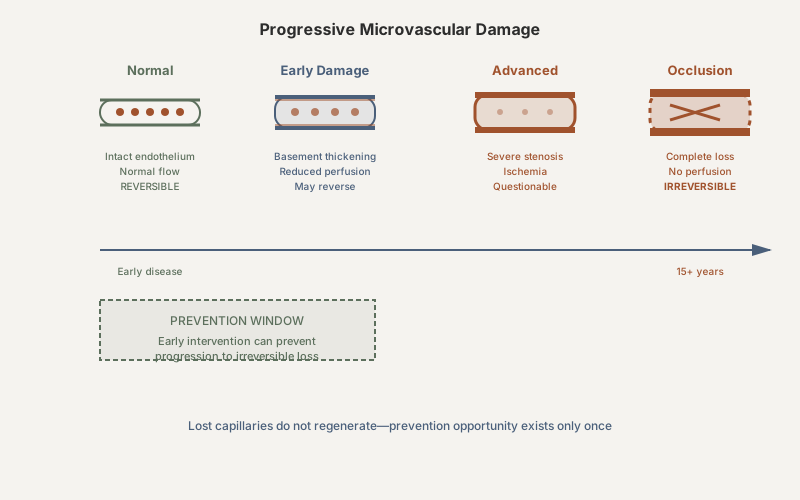
Microvascular damage exists on a spectrum from functional impairment to structural destruction. Early changes—endothelial dysfunction, increased permeability, reduced nitric oxide production—can reverse if metabolic conditions improve before permanent structural damage occurs. At this stage, capillaries remain intact but function abnormally. Restoration of normal glucose levels and reduction of oxidative stress allows endothelial recovery.
But beyond certain thresholds, damage becomes irreversible. When substantial numbers of endothelial cells undergo apoptosis and capillaries collapse, they are lost permanently. Adult tissues have minimal capacity for angiogenesis—new capillary formation—particularly in the specialized microvascular beds of retina, glomeruli, and nerves. Lost capillaries mean permanently reduced blood flow to dependent tissues.
In the retina, this progression is clinically visible. Mild non-proliferative retinopathy shows microaneurysms and small hemorrhages—early changes that may stabilize or partially reverse with metabolic improvement. Moderate retinopathy with extensive hemorrhages and cotton-wool spots indicates more advanced capillary damage with questionable reversibility. Proliferative retinopathy, where abnormal new vessels grow in response to ischemia, represents severe irreversible damage where prevention of further progression becomes the only realistic goal.
Similarly, kidney damage progresses from microalbuminuria—early glomerular dysfunction that may reverse—to overt proteinuria indicating substantial capillary destruction, to declining glomerular filtration rate signaling permanent nephron loss. Once kidney function drops below certain levels, progression to failure becomes nearly inevitable regardless of metabolic improvement. The window for reversal closes as structural damage accumulates.
Why Duration of Hyperglycemia Determines Damage
The relationship between diabetes duration and microvascular complications is not linear but exponential. Initial years of modest hyperglycemia produce minimal detectable capillary damage. Endothelial cells compensate. Protective mechanisms remain functional. Patients feel fine and laboratory markers appear acceptable.
But compensatory capacity eventually exhausts. After five to ten years of continuous metabolic stress, protective systems begin failing. Antioxidant defenses deplete. Repair mechanisms slow. The rate of damage accelerates while healing capacity declines. Capillary injury accumulates faster than tissues can repair it.
This explains the clinical observation that complications often appear suddenly after many years of apparently stable diabetes. The damage was accumulating silently throughout those years, remaining below the threshold of clinical detection. When critical thresholds are finally crossed—when enough capillaries have been lost, when sufficient structural damage has accumulated—symptoms manifest rapidly. What appears as sudden deterioration actually represents the culmination of years of progressive subclinical damage.
This temporal pattern creates urgency for early aggressive intervention. The first five years of diabetes represent maximum opportunity for prevention. Microvascular beds retain reversibility. Protective systems still function. Aggressive metabolic correction during this window can prevent most microvascular complications. Waiting until year ten or fifteen means intervening after substantial irreversible damage has occurred—too late to prevent the complications that earlier intervention would have avoided.
The Inadequacy of Glucose Control Alone
Clinical trials demonstrate that intensive glucose control reduces but does not eliminate microvascular complications. The DCCT and UKPDS studies showed that maintaining near-normal glucose levels substantially decreased retinopathy, nephropathy, and neuropathy risk compared to conventional treatment. But even in intensively treated groups, complications still developed—at lower rates, but not rarely.
This incomplete protection reflects that glucose lowering addresses only one mechanism of microvascular damage while leaving others active. Intensive insulin therapy reduces glucose toxicity but may not adequately address oxidative stress, inflammation, or advanced glycation product accumulation. Some patients achieve excellent HbA1c yet develop progressive complications because other pathological processes continue operating.
Additionally, glucose variability—not captured by average measures like HbA1c—independently drives microvascular damage. Large swings between hyperglycemia and relative hypoglycemia generate oxidative stress bursts more damaging than stable moderate elevation. Patients with identical HbA1c but different glucose variability patterns show different complication rates. Intensive management focused only on average glucose may miss this critical variability component.
Comprehensive microvascular protection requires addressing all damage mechanisms: glucose normalization, reduction of glucose variability, oxidative stress reduction, inflammatory control, and reversal of metabolic conditions promoting advanced glycation. Glucose management remains essential but insufficient alone—microvascular protection demands multi-faceted intervention.
Implications for Treatment Timing and Intensity
Recognition that microvascular damage becomes irreversible beyond certain points argues for maximum intervention intensity early in disease course. The traditional approach of stepwise medication escalation—starting with minimal treatment and intensifying gradually as glucose control deteriorates—allows years of suboptimal control during which preventable microvascular damage accumulates.
A more aggressive early approach—pursuing near-normal glucose levels and comprehensive metabolic correction from diagnosis—better protects microvasculature during the critical early years when reversibility remains possible. This requires accepting greater treatment burden initially but offers the benefit of preventing complications that will require far greater intervention if allowed to develop.
For patients with established diabetes duration, assessment of existing microvascular damage determines realistic goals. Those with minimal retinopathy, no proteinuria, and intact nerve function retain substantial reversibility potential. Intensive intervention can prevent progression and allow partial healing of early changes. Those with advanced retinopathy, significant proteinuria, or established neuropathy face limited reversal possibility—goals shift from reversal to preventing further deterioration and managing existing complications.
The Window That Cannot Reopen
Perhaps the most critical insight regarding microvascular complications is that prevention opportunities exist only once. Early in disease, intervention can prevent capillary damage from occurring. But once capillaries are lost, once glomeruli scar, once nerve fibers degenerate—these changes are permanent. No subsequent intervention, regardless of intensity, can restore destroyed microvascular beds or regenerate lost tissue.
This creates a temporal asymmetry in diabetes care: aggressive early intervention offers enormous protective benefit, while delayed intensive treatment provides limited reversal of established damage. A patient achieving excellent glucose control after fifteen years of poor control will still progress to complications seeded during those fifteen years. Their improved control prevents new damage but cannot reverse structural changes already present.
This reality demands rethinking conventional diabetes management that tolerates years of suboptimal control as patients gradually escalate treatment. Every year of inadequate metabolic correction allows preventable microvascular damage that will manifest as complications decades later. The patient who receives intensive intervention at diagnosis may never develop retinopathy. The patient who waits until complications appear before pursuing aggressive control has already lost that preventive opportunity permanently.
For patients already beyond the early window, this recognition should not create hopelessness but rather urgency to prevent further damage. While existing injury cannot reverse, slowing progression and preventing additional complications remains achievable. Every capillary preserved, every nephron protected, every nerve fiber maintained represents meaningful benefit even when complete reversal is impossible.